PPM without a PMO: make project management part of normal management
Do you need a Project Management Office to manage a portfolio of projects effectively?
Not necessarily.
In our experience, project operations often work best when they are integrated as closely as possible into the normal line organization and its management structure. Instead of creating a separate organization to oversee projects, responsibility for projects and portfolios can follow the same management structure that already exists in the company.
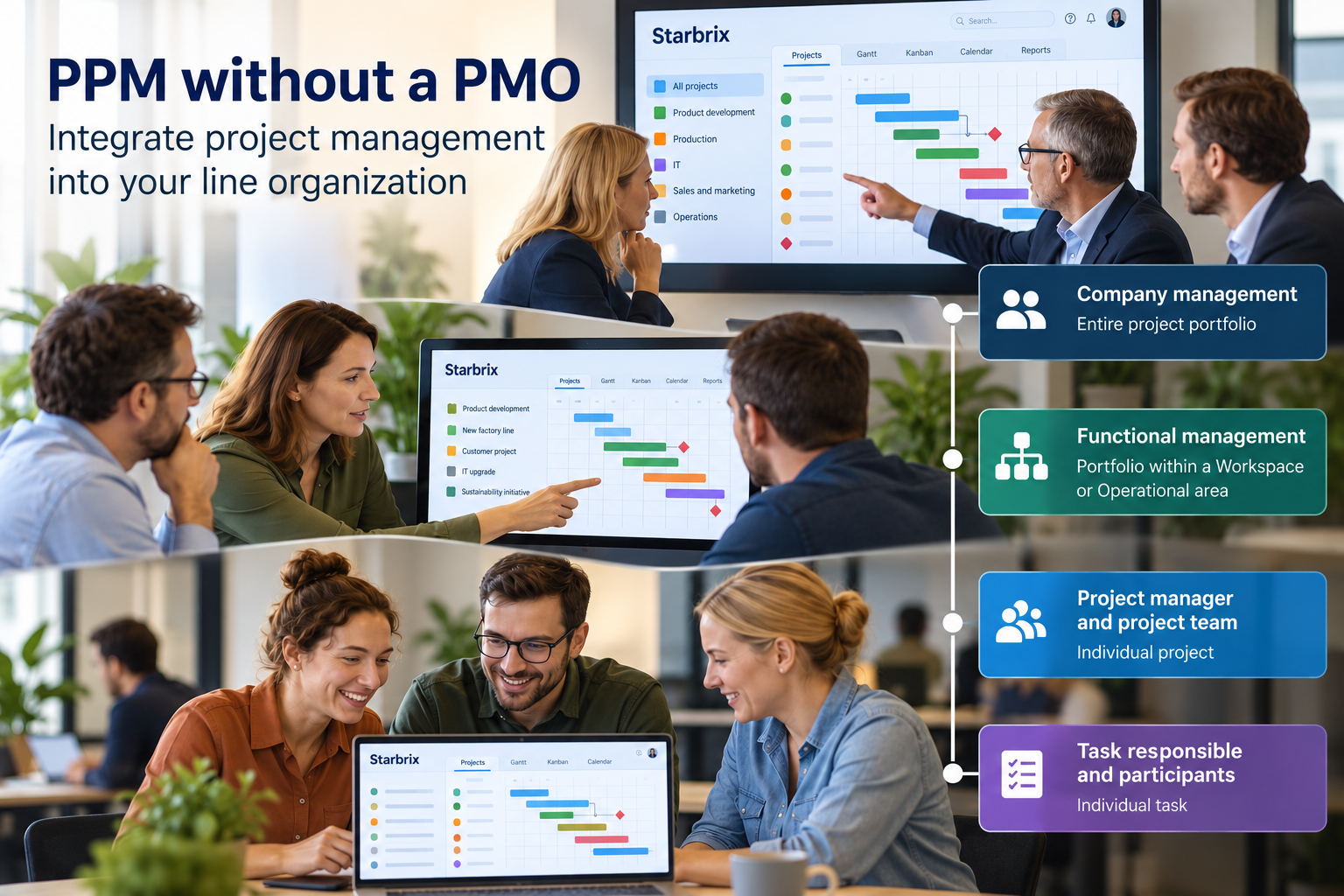
The CEO and management team oversee the company-wide project portfolio. Functional management teams oversee the projects within their areas. Project managers and project teams manage individual projects. And within each project, each task has a responsible person who takes responsibility for the work.
The principle is simple:
PPM without a PMO doesn't mean PPM without governance. It means making project and portfolio management part of normal management.
A project management system should support that structure rather than create another organizational layer around it.
1. Put portfolio responsibility in the line organization
Portfolio management starts at the top.
The CEO and management team should be able to see the projects taking place across the company and understand how the overall portfolio is developing.
Both Starbrix Core and Starbrix Flex provide views covering all projects in the organization. This gives management a shared view of the company's project activities without requiring someone to collect the information separately for a management meeting.
Responsibility can then follow the organization's normal structure.
For example, the management of product development can oversee the product development portfolio, while production management oversees projects related to production.
In Starbrix Core, these portfolios can be organized using Workspaces.
In Starbrix Flex, the corresponding structure is called Operational areas.
This creates a natural hierarchy:
Company management → entire project portfolio
Functional management → portfolio within a Workspace or Operational area
Project manager and project team → individual project
Task responsible and participants → individual task
The people who already have responsibility for the business therefore also have responsibility for the projects connected to it.
Keep responsibility where the work happens
Every project should have a project manager and a project team. Larger or strategically important projects may also have a project owner.
They are responsible for managing the project.
Projects are then divided into tasks. Each task has a responsible person and, where necessary, other participants. They are responsible for completing and updating their work.
This creates clear ownership without adding another administrative organization on top of the existing one.
The portfolio should provide visibility and support decisions. It should not take responsibility away from the projects themselves.
2. Create common ways of working – without unnecessary bureaucracy
PPM works much better when projects follow some common principles.
That doesn't mean every project must be identical.
Different types of projects may require very different structures, workflows and levels of detail. A product development project, an internal IT project and a customer delivery project may have little in common.
This is where project templates become useful.
In Starbrix, you can create different templates for different purposes. A template can provide a ready-made starting point for a new project, including the appropriate project structure, phases and tasks.
Instead of defining every new project from scratch, the organization can gradually develop templates based on what has worked well in previous projects.
The goal is not standardization for its own sake. The goal is to make good project practices easy to reuse.
Agree on simple rules for using Starbrix
The organization should also agree on some basic rules for how project information is maintained.
For example:
- What information should be entered, and where?
- Who is responsible for keeping it up to date?
- When should project and task information be updated?
- Who is allowed to change schedules, responsibilities or other key information?
- What should be handled at portfolio level, and what belongs inside the individual project?
Keep these rules as simple and natural as possible.
If maintaining the system becomes a separate administrative exercise, people will eventually stop doing it. Updating Starbrix should instead be part of managing and carrying out the actual work.
3. Manage portfolios as part of the normal management rhythm
Portfolio reviews don't necessarily require a separate PMO meeting.
They can be incorporated into the organization's existing management routines.
Depending on the number and pace of projects, a management team might review its project portfolio weekly, every second week or monthly.
Company management can review the overall portfolio, while functional management teams can review their respective Workspaces or Operational areas in more detail.
The purpose is not to discuss every task in every project.
The portfolio review should focus on the management perspective: overall progress, important changes, delays, dependencies, priorities, resource conflicts and issues requiring management decisions.
Detailed project matters should normally be handled within the project by the project manager and project team.
This keeps portfolio management at the right level.
Let Starbrix highlight what needs attention
Management shouldn't have to discover delays by asking every project manager individually.
Both Starbrix Core and Starbrix Flex make delays visible with red dates and symbols and can send notifications when something becomes overdue.
It is also worth deciding in advance which other events should trigger notifications.
The right notifications depend on how your organization works. The important point is to configure them intentionally so that relevant people receive information when something requires their attention.
This supports management by exception: normal work continues within projects, while significant deviations become visible to the people who need to act.
Appoint a Starbrix contact person
There is one supporting role we recommend even when an organization doesn't have a PMO: appoint a Starbrix contact person or key user.
This person does not take responsibility for the project portfolio. Portfolio responsibility remains with company and functional management, and responsibility for individual projects remains with project managers and project teams.
Instead, the contact person acts as the link between your organization and Starbrix.
The contact person can:
- collect questions from users and contact Starbrix when help is needed
- request walkthroughs or training when new needs arise
- help coordinate how Starbrix is used within the organization
- report possible bugs or problems
- collect improvement ideas from users
- communicate development suggestions to Starbrix
This provides a simple support structure without creating a separate project management organization.
Your project management model should keep evolving
There is another reason why having a contact person and regular portfolio discussions is valuable:
Project management is never finished.
Organizations change. Customers change. Technology changes. New regulations, new business models and new ways of working appear. Projects that were unusual five years ago may become normal, while entirely new situations emerge.
The way an organization manages projects therefore needs to evolve as well.
Sometimes that means changing responsibilities or management practices. Sometimes it means improving a project template. Sometimes a new type of notification, portfolio view or workflow is needed.
And the project management tool must be able to evolve with those requirements.
This is why we see project management as a process of continuous improvement rather than something that can be designed once and then left unchanged.
Organizations develop their project practices, users provide feedback and new requirements emerge. Those experiences can also generate ideas for how Starbrix itself should be improved.
The organization and the tool develop together.
A practical model for PPM without a PMO
For many organizations, lightweight portfolio management can therefore be surprisingly straightforward.
At company level, the CEO and management team oversee the complete project portfolio.
At functional level, managers oversee the projects belonging to their part of the organization through Workspaces in Starbrix Core or Operational areas in Starbrix Flex.
At project level, the project manager, project owner where applicable, and project team manage the project.
At task level, task responsible and participants take responsibility for their own work.
Across the organization, common project templates and simple rules provide enough consistency for information to be useful across projects.
At regular intervals, management reviews the relevant portfolio as part of its normal management rhythm.
Starbrix notifications and visual indicators help bring delays and other exceptions to attention.
And a Starbrix contact person provides a practical link between users and Starbrix as requirements and ways of working continue to evolve.
Start simple
If you are introducing portfolio management without a PMO, don't start by designing a large governance framework.
Start with the organization you already have.
Decide which management team is responsible for which portfolio. Make sure every project has clear ownership. Make sure tasks have responsible people. Agree on a few simple rules about what should be updated, by whom and when.
Create project templates where common structures are useful.
Configure the most important notifications.
Then add portfolio reviews to the normal management rhythm and improve the model based on experience.
The objective isn't to create more project administration.
It is to make projects a visible and manageable part of the way the organization is already led.
FAQ: PPM without a PMO
What does PPM without a PMO mean?
It means managing projects as a portfolio without creating a separate Project Management Office. Responsibility for project portfolios is integrated into the normal line organization: company management oversees the company-wide portfolio, functional management oversees its projects, and project managers remain responsible for individual projects.
Who should own the overall project portfolio?
Typically, the CEO and management team should have visibility of and responsibility for the company-wide project portfolio. Responsibility for subsets of the portfolio can then follow the normal organizational structure, such as product development, production, IT or other functions.
How are portfolios organized in Starbrix?
Both Starbrix Core and Starbrix Flex provide views across the organization's projects. In Starbrix Core, projects can be grouped into portfolios using Workspaces. In Starbrix Flex, Operational areas provide the corresponding organizational structure.
How often should the project portfolio be reviewed?
There is no single correct interval. Depending on the organization and the pace of its projects, a portfolio review may take place weekly, every second week or monthly. It can usually be incorporated into the normal meetings of the relevant management team.
Do all projects need to follow the same structure?
No. Different types of projects have different needs. Starbrix allows organizations to create different project templates for different purposes. This provides consistency where it is useful without forcing every project into the same model.
How should delays be handled?
Both Starbrix Core and Flex make delays visible using red dates and symbols and can send notifications when something becomes overdue. Organizations can also configure other useful notifications so the right people are informed when attention or action is needed.
Do we need someone to administer Starbrix?
You don't necessarily need a separate administrator or PMO, but appointing a Starbrix contact person or key user is useful. This person can coordinate questions and training, report problems and bugs, and communicate improvement ideas and new requirements to Starbrix.
Can this model evolve as our organization changes?
It should. Project requirements and ways of working change continuously. New situations create new requirements for processes, templates, reporting and tools. Your project management model should therefore be reviewed and improved over time, and Starbrix can evolve alongside it.